

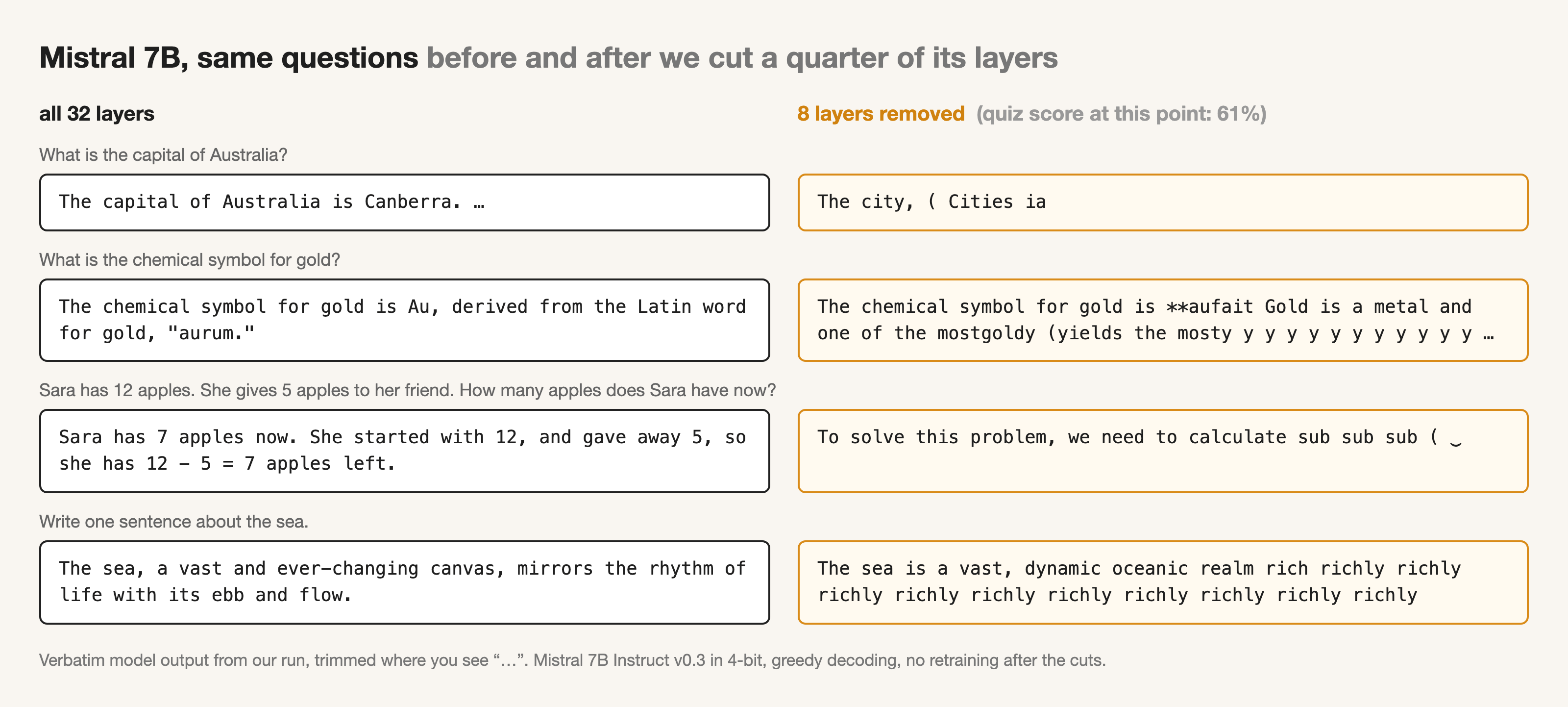
We pulled a quarter of the layers out of a real AI model, Mistral 7B, and gave it the same quiz of 700 multiple-choice questions. Before the cut, it got 66% right. After the cut, it still got 61%.
Then we asked it, with no options to choose from, what the capital of Australia is. It wrote “The city, ( Cities ia” and went blank.
That one run shows why bigger models still get better, and why each step costs far more than the one before. It also shows a part of the error that no amount of money removes.
If you prefer the video version of this blog post on my Youtube channel:
What a Layer Does
A model like the one behind ChatGPT is a stack of layers. Your question enters at the bottom as a long list of numbers. Each layer reads those numbers, makes a small edit, and passes them up. At the top, the model reads the result and picks the next word.
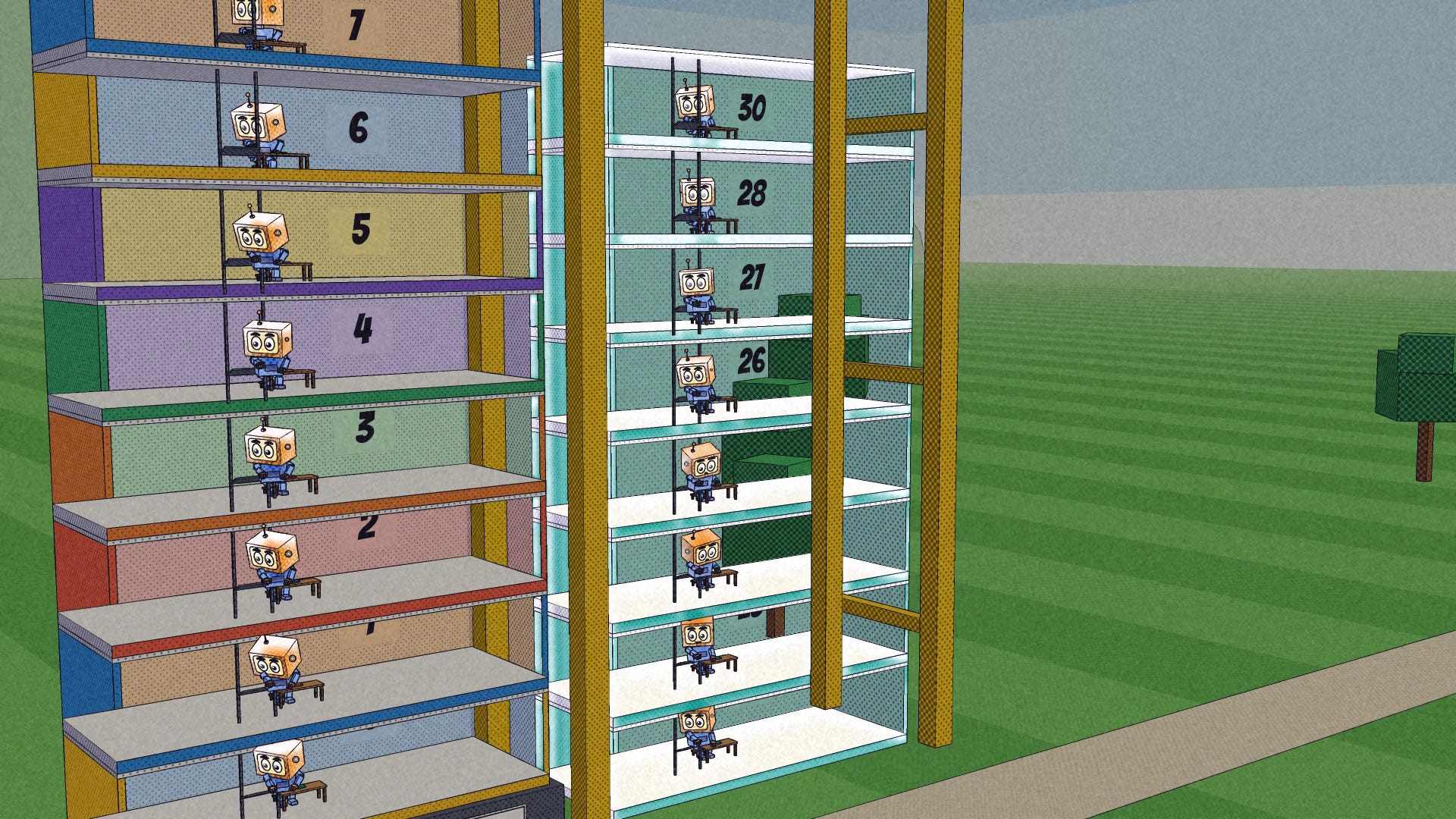
Think of it as a tower. Your question rides up through every floor, and each floor tweaks it a little. Mistral 7B has 32 floors.
Adding floors is one of the main ways labs make a model bigger, and one training run of a frontier model costs hundreds of millions of dollars. So it is fair to ask what all those floors really do.
How We Cut the Model
We removed the floors one at a time, starting with the ones that changed the numbers the least. We did not retrain anything. After each cut, the model took the same quiz again.
For the first few cuts, the score barely moved. With 8 of the 32 floors gone, it still scored 61%. Two more cuts, and it fell to pure chance, no better than random guessing.
So a quarter of the tower looked almost useless. Until we asked the model to write.
Why Writing Broke First
With those 8 floors still gone, we asked five simple questions with no answers to pick from. All five answers fell apart.
A quiz and a sentence are different jobs. On a quiz, the model has to lean the right way once, toward A, B, C or D. In a sentence, it has to lean the right way on every word, and each word is built on the words before it. One small mistake early becomes the input for the next word, and the mistakes pile up.
It is like a student who can still spot the right answer on a multiple-choice test, but can no longer write the essay.
Not every model is this forgiving. A smaller one, Qwen2.5 3B, lost points from the very first cut.
Why the Layers Repeat
We compared what each floor hands up with what it received. In the upper middle of the tower, the two were almost the same. Floor after floor made nearly the same small edit.
Researchers at MIT found the same pattern in large language models this February. They think the middle floors work like a committee. Picture ten people who read the same draft and each suggest almost the same small fix. Average their fixes, and each person’s small mistakes partly cancel out.
That is why a quarter of Mistral could go. A smaller committee still gets one vote right, so the quiz survives. A sentence needs the full committee on every word.
The picture has a limit, and the researchers say so. Floors work in a line, each one editing what the floor below handed up, and some floors may still have jobs of their own.
Why Bigger Pays Less
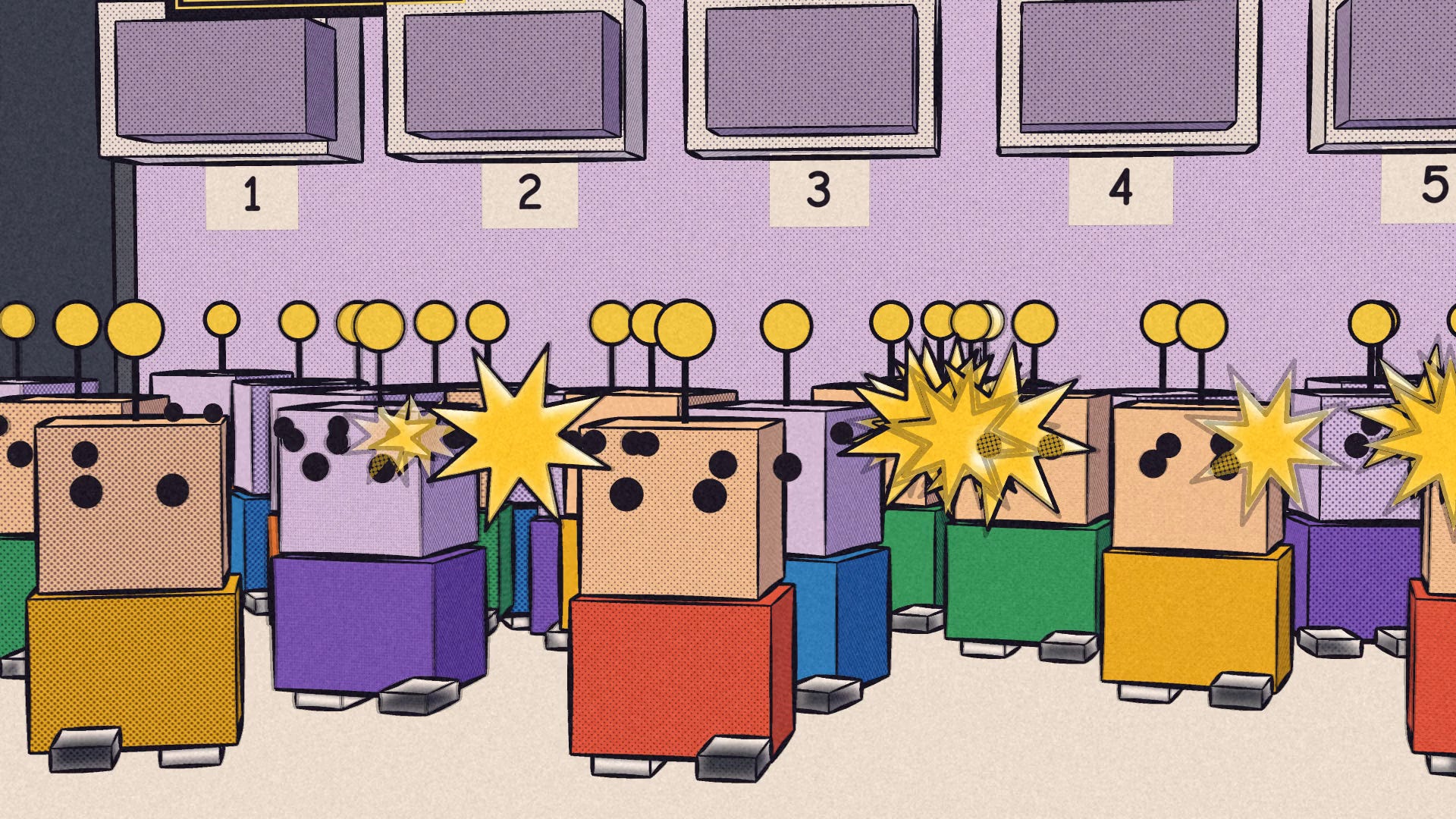
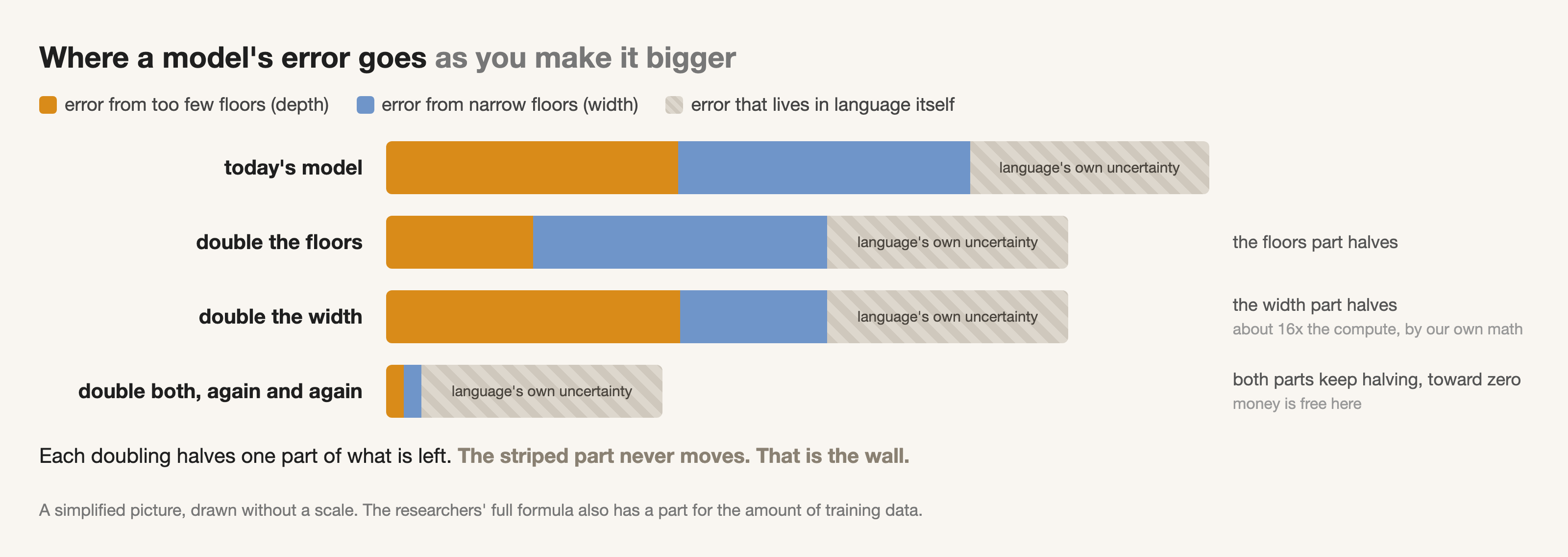
The committee also explains why growing gets expensive. Every new member adds less than the one before. The MIT team found that doubling the floors cuts this error roughly in half, and the next doubling halves only what is left.
The other way to grow is to make each floor wider. Mistral has to fit tens of thousands of word pieces, plus every fact and idea it knows, into far fewer slots on each floor. So ideas share slots and blur into each other, like too many people in a small room. This is called superposition. The same lab showed that a floor twice as wide roughly halves that blur.
Taller or wider, the rule is the same: each doubling halves one part of the error, and only that part. A rule like this, for how much a model improves as it grows, is what people call a scaling law.
What Each Step Costs
A floor twice as wide holds about four times the numbers, because its connections grow with width times width. Labs also grow the training data to match the model. Four times the numbers, trained on four times the data, needs sixteen times the computing power.
So by our own math, halving the width part of the error once costs about 16 times the compute. Halving it again costs 16 times that.
Even with free money, every doubling fixes only half of what is left. And one part of the error never moves at all.
The Error No Model Removes
Finish this sentence: “I really like...”
Pizza, maybe, or my dog, or you. There is no single right answer, so even an endlessly big model has to guess.
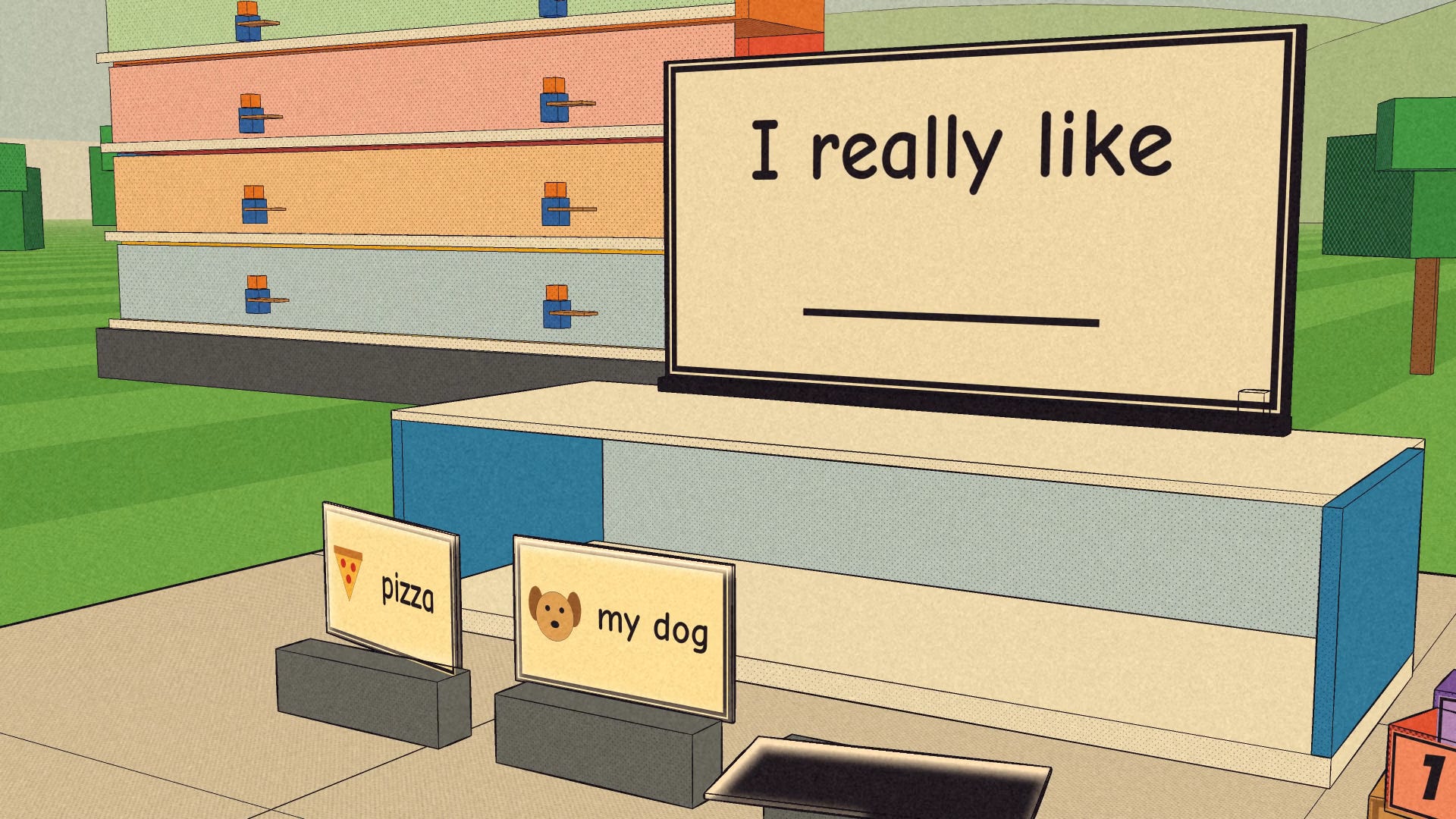
That guessing lives in language itself, and researchers call it the irreducible loss. More floors cannot remove it, and wider floors cannot either. That is the wall, and no budget gets through it.
What This Means for You
Few of us will ever train a frontier model. But we all choose models and decide when an upgrade is worth the money. Two things change.
Test what you ship. A smaller or compressed model can score almost the same on a public leaderboard and still write badly, because the leaderboard asks multiple-choice questions. Before you switch, run a few dozen of your real requests through both models and read the answers. Read the long answers most closely, because that is where mistakes pile up.
Name the error before you pay for a bigger model. If the model misses facts or loses track in long answers, that is a size limit, and a bigger model usually helps. If your request had many good answers and the model picked one you did not want, that is the wall. A bigger model would have to guess too. Fix it with context: who the answer is for, the format you want, an example of a good result.
What We Still Don’t Know
This is one model, in a compressed 4-bit version, with no retraining after the cuts. Larger models usually have more floors to spare. The committee is still the researchers’ best explanation, and they say that themselves. Better data and better designs can also make the same size smarter.
The researchers think the way past all that repeating is a new design, where each floor does a different job. That is what I want to test next.
Until then, labs will keep building bigger and paying more for every step toward the wall. The part you control is what you send up the tower and what you check when the answer comes down. That system around the model is most of what building with AI is.