

4-5 minute read
The release of GPT-5 got me thinking about where AI is heading. While it's an improvement, the jump isn't as dramatic as previous generations. This pattern is appearing across the industry, signaling that simply building bigger models is no longer delivering the breakthroughs we're used to.
I'm writing this because we're entering the most exciting phase of AI development yet - one that will require completely new approaches beyond just scaling up.
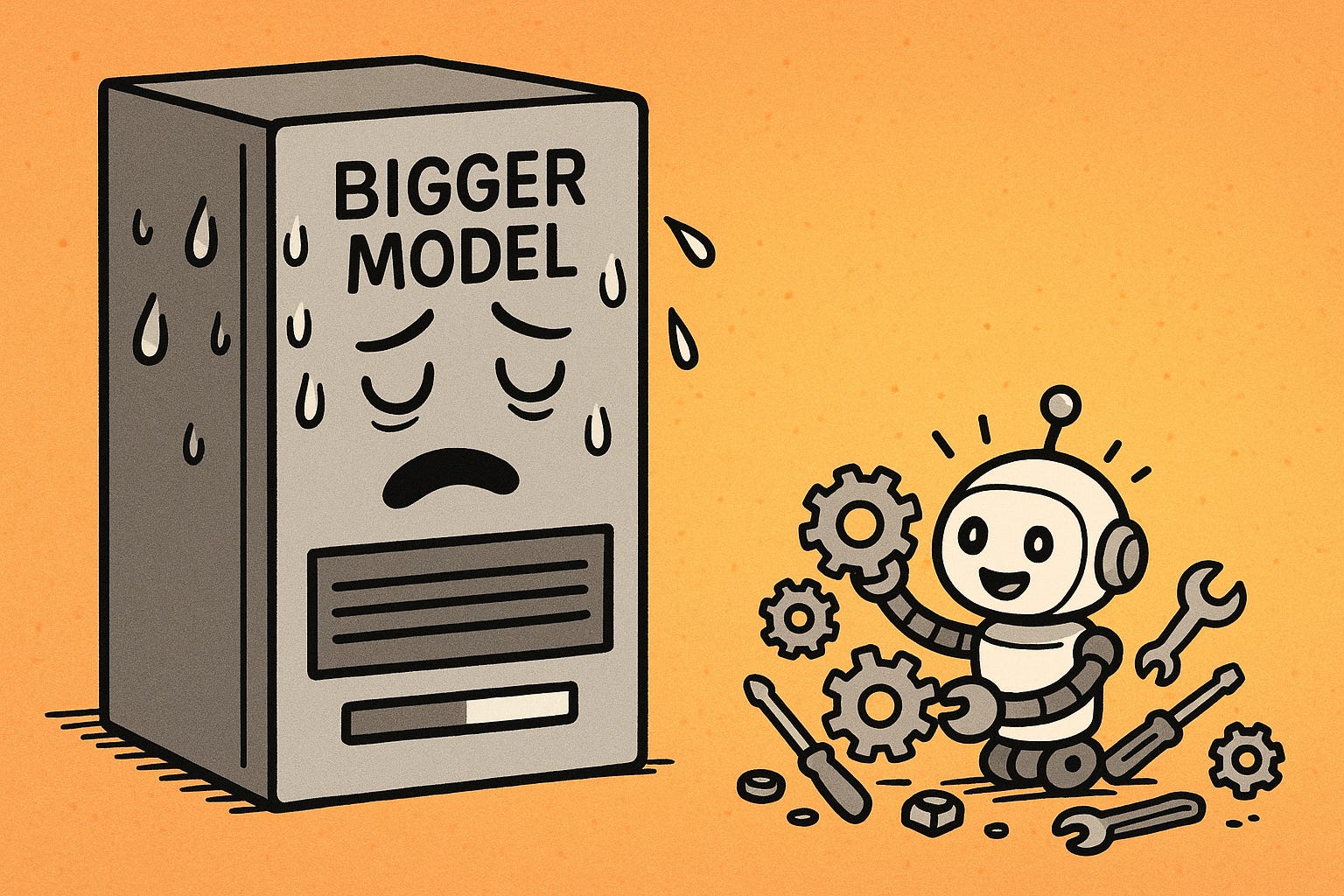
The Scaling Method Is Failing
For ten years, the recipe for AI breakthroughs was simple: make models bigger and train them longer. GPT-3 amazed us by writing human-like essays. GPT-4 solved test questions and understood pictures. Each jump felt massive.
But that's changing. GPT-4 was much better than GPT-3, but newer models show much smaller improvements. Other AI companies report the same pattern. Adding more parameters and data no longer creates the dramatic leaps we're used to.
This doesn't mean AI progress stopped - it means we've hit the limits of our current approach. Even the biggest advocates of scaling now admit we need completely new ideas to reach the next level.
Smart Engineering - Maximizing Current AI
If we can't just make models bigger forever, how can we make current AI work better? The good news is that we can make today's AI much more useful with clever tricks.
For example, instead of trying to make one model remember everything, we can connect it to databases or the internet. This way, it can look up current information when it needs it. We can also teach AI to break down hard problems into smaller steps, just like humans do. This often gives better answers than trying to solve everything at once.
Engineers are also making AI handle different types of information at the same time, like text and pictures together. They're also increasing how much information the AI can work with at once. These aren't completely new technologies - they're smart ways to use what we already have better.
Data and Computing Limits
The scaling approach is hitting two concrete walls. First, we've used most of the high-quality text on the internet. What remains is low-quality or repetitive. Training AI on AI-generated content creates error loops that make models worse.
Second, the computing costs are exploding. Making a model slightly better now requires exponentially more processing power and electricity. This quickly becomes too expensive and environmentally unsustainable.
New AI Architectures Needed
The type of AI design we use now (called "Transformers") has worked very well. But it also has some basic problems. Models like GPT work by guessing what word comes next in a sentence. This makes them very good at copying patterns from their training data, but it doesn't mean they truly understand what the words mean.
No matter how big we make these models, they might still fail at tasks that need real reasoning or understanding. This is why many researchers think that just making the same type of AI bigger won't give us human-like intelligence.
To break through this barrier, we probably need completely new ways to build AI. Some ideas include:
AI that learns by interacting with the real world (not just reading text)
AI systems with special parts for memory and reasoning
AI that can truly understand cause and effect
These new ideas are still being tested, but they might be the key to the next big jump in AI ability.
Building AI That Self-Corrects
Another important area is making AI reason better and double-check its own answers. Today's AI can solve complex problems, but it often needs us to tell it how to think step by step.
For example, if we ask an AI to "think step by step," it will show us its reasoning process and usually give a better answer. This shows that AI can reason, but it doesn't always do it unless we specifically ask.
Researchers have also found that having one AI check another AI's work can catch mistakes and improve results. The goal is to give AI an "inner voice" that can notice when something might be wrong.
In the future, we want AI that can say "Wait, that answer doesn't look right, let me try again." If we can build AI that checks and improves its own thinking, it will be much more reliable and work more like human problem-solving.
AGI - Hype vs Reality
Many people think that just making current AI bigger will eventually create artificial general intelligence (AGI) - AI that can do anything a human can do. But this probably isn't true.
Real general intelligence likely needs abilities that current AI doesn't have, such as:
Learning completely new tasks by itself
Setting its own goals
Understanding the physical world like humans do
Current AI models don't really do these things. So while each new model might be somewhat better, it won't suddenly become a thinking machine with human-like common sense.
Getting to AGI will probably require major scientific breakthroughs and careful work to make sure it's safe. It's not something that will happen very soon just by making models bigger.
The New Era of AI Innovation
The scaling slowdown isn't a problem - it's an opportunity. When one approach reaches its limits, researchers diversify and innovate. We're now seeing investment in multiple promising directions: better architectures, self-correcting systems, reasoning capabilities, and novel training methods.
Future AI progress will be more varied and sophisticated than simply making bigger models. The path to human-like AI is still being built, and we're moving forward on multiple fronts simultaneously.
Luckily, the LLM hype is coming to an end. Thank you, GPT-5. That was not expected. 😊
I mostly agree but to be short - AI checking AI is always was, is and will be BIASED let's not forget that we have bigger bias in AI than in any other plaace. Bias is key to realizing why AI is not that good.
Finally I have reado numerous papers, scientific ones which not simply claim but prove AGI is impossible due to infinite loop of dilemma within own machine links